The United States net worth charts by race reveal a stark reality about the financial inequalities that exist between different racial groups in America. The narrative of this issue is complex and multifaceted, shaped by centuries of systemic inequalities, economic policies, and societal norms.
As we explore the historical context of racial disparities in net worth, we begin to see a pattern of exclusion and marginalization that has led to the significant financial gaps between white Americans and people of color. This issue is not just a problem of individual circumstance, but rather a result of systemic inequalities that have been perpetuated for centuries.
Historical Context of Racial Disparities in Net Worth
The United States has long grappled with the issue of racial disparities in net worth, a problem that is deeply ingrained in its history. From the institution of slavery to the present day, various economic policies and societal norms have contributed to the significant wealth gap between Whites, Blacks, and other racial and ethnic groups.The legacy of slavery, a system that forcibly extracted labor and wealth from enslaved people, laid the foundation for racial disparities in net worth.
Enslaved people were denied the right to own property, earn wages, and accumulate wealth, leaving them with little to no assets at the end of the transatlantic slave trade. This historical injustice has had a lasting impact on the economic well-being of Black people in the United States.
The Impact of Jim Crow Laws
Jim Crow laws, enforced from the late 19th to the mid-20th centuries, further exacerbated racial disparities in net worth. These laws, which mandated segregation in public facilities, restricted voting rights, and enforced racial quotas in employment, limited the economic opportunities available to Black people. As a result, many Black people were forced to live in poverty-stricken neighborhoods, work low-wage jobs, and struggle to access basic necessities like healthcare and education.
Systemic Inequalities in Education and Employment
The effects of Jim Crow laws can still be seen today in the education and employment systems. Historically, Black schools were underfunded, overcrowded, and lacking in resources, which has led to a persistent achievement gap in education. This, in turn, has made it more difficult for Black people to secure high-paying jobs and climb the economic ladder.
Racial Disparities in Homeownership and Wealth-Building
Homeownership, a key factor in building wealth, has long been unavailable to many Black families. Redlining, a practice that denied Black people access to mortgage credit and affordable housing, perpetuated segregation and limited access to wealth-building opportunities. Even today, Black people are more likely to live in neighborhoods with degraded housing stock, higher crime rates, and limited access to economic resources.
The Long-Term Consequences of Racial Disparities in Net Worth, The united states net worth charts by race
The ongoing impact of slavery, Jim Crow laws, and systemic inequalities can be seen in the current net worth disparities between Whites, Blacks, and other racial and ethnic groups. According to the US Census Bureau, in 2020, White families held an average of $171,000 in wealth, while Black families held just $17,600. This means that White families, on average, have over 9 times more wealth than Black families.
A Path Forward to Addressing Racial Disparities in Net Worth
To address these disparities, policymakers and community leaders must work together to implement policies that promote economic equity and address the historical injustices that have led to racial disparities in net worth. This may include investing in education and employment programs, increasing access to affordable housing and credit, and providing reparations for the long-term impact of slavery and Jim Crow laws.
Learn more about the history and impact of racial disparities in net worth.
Median Net Worth by Race

The United States has long been a melting pot of cultures and ethnicities, each contributing to the diverse tapestry that makes up the country. However, when it comes to economic prosperity and access to wealth, there exists a stark contrast between different racial groups. Recent data from the Federal Reserve highlights the alarming disparities in median net worth among white Americans and people of color.According to a 2022 report by the Federal Reserve, the median net worth of white families in the United States stood at $171,000, compared to a mere $38,700 for Black families, $24,100 for Hispanic families, and $23,400 for Indigenous families.
These numbers underscore the glaring racial disparities in wealth accumulation, access to education, and job opportunities that have been perpetuated throughout American history.Let’s dive deeper into the specifics of these disparities through the lens of data.
Median Net Worth by Race: A Table Breakdown
A closer examination of the data reveals the following trends:
| Median Net Worth | Average Family Size | Geographic Location | Income Level |
|---|---|---|---|
| Whites: $171,000 | 2.65 individuals | Suburban areas, urban centers | $74,600 household income |
| Blacks: $38,700 | 2.93 individuals | Urban centers, low-income neighborhoods | $43,100 household income |
| Hispanics: $24,100 | 3.55 individuals | Urban centers, rural areas | $38,400 household income |
| Indigenous: $23,400 | 3.23 individuals | Rural areas, reservations | $34,400 household income |
These numbers paint a dire picture of the wealth disparities that persist in the United States. The median net worth of white families is nearly 5 times that of Black families and over 7 times that of Hispanic and Indigenous families. This staggering difference in wealth accumulation has severe implications for social mobility, access to quality education, and job opportunities.
Geographic Location and Income Level: Contributing Factors
The data also highlights the relationship between geographic location, income level, and median net worth. Urban areas tend to have higher median net worth compared to rural areas, reflecting the concentration of wealth-generating opportunities in these regions. Similarly, families with higher household incomes tend to have greater access to wealth-building resources, such as education and job opportunities.The implications of these disparities are far-reaching and multifaceted.
Closing the racial wealth gap will require a concerted effort to address the systemic inequalities that have been perpetuated throughout American history. Policymakers, educators, and community leaders must work together to create a more equitable and inclusive economic landscape that provides opportunities for all individuals to build wealth and achieve social mobility.
Homeownership Rates and Net Worth

Homeownership has long been considered a key component of building wealth and achieving financial stability in the United States. Yet, despite its importance, the nation’s homeownership rates have shown a significant disparity across racial lines, with white Americans consistently outpacing their counterparts of color. In this section, we’ll explore the complex relationship between homeownership and net worth, examining how differences in homeownership rates and property values contribute to the wealth gap between white Americans and people of color.
The Historical Context of Homeownership Disparities
Throughout much of the 20th century, homeownership rates among white Americans soared, thanks in part to government-backed housing policies and programs designed to promote suburbanization and homeownership. In contrast, people of color faced significant barriers to homeownership, including redlining, restrictive covenants, and other forms of discriminatory lending practices. As a result, homeownership rates among African Americans and Hispanics lagged far behind those of white Americans.
The Consequences of Homeownership Disparities
The consequences of these disparities have been far-reaching and devastating. According to data from the Federal Reserve, median net worth among white Americans has consistently outpaced that of African Americans and Hispanics, with a notable gap emerging in the 1990s. This disparity can be attributed, in part, to differences in homeownership rates and property values. For example, a study by the Urban Institute found that the average home value among African Americans is roughly $120,000, compared to $170,000 among white Americans.
Similarly, a report from the National Association of Realtors notes that the median home purchase price among African Americans is over 30% lower than that of white Americans.
Homeownership Rates by Racial Group
- According to data from the U.S. Census Bureau, the homeownership rate among white Americans stood at 73.4% in 2020, compared to 41.7% among African Americans and 47.5% among Hispanics.
- The homeownership rate among white Americans has been on a steady upward trend since the mid-1990s, while the rates among African Americans and Hispanics have remained relatively stagnant or declined.
- In 2020, the median age of first-time homebuyers among white Americans was 32.4, compared to 36.4 among African Americans and 38.4 among Hispanics.
The Impact of Homeownership on Net Worth
Homeownership is a key driver of wealth accumulation in the United States, with the majority of household wealth tied up in home equity.
According to a report by the Joint Center for Housing Studies of Harvard University, homeownership has a significant impact on net worth, particularly for individuals of color. The report notes that, on average, homeownership can add $70,000 to an individual’s net worth, with this amount rising to over $100,000 for African Americans and Hispanics.
Breaking Down the Barriers to Homeownership
As we move forward, it’s essential to address the systemic barriers that have prevented people of color from realizing their dream of homeownership. This includes:
- Addressing discriminatory lending practices and improving access to affordable credit.
- Implementing policies to increase the availability of affordable housing and reduce the gap in home values between white and minority communities.
- Providing support and resources for minority homebuyers, such as education and counseling programs.
By working together to address these disparities, we can begin to bridge the wealth gap and create a more equitable homeownership landscape for all Americans.
Intergenerational Wealth Transfer and Net Worth

In the United States, the transfer of wealth from one generation to the next plays a significant role in shaping the net worth disparities between racial groups. As one might expect, this intergenerational wealth transfer is often driven by family dynamics, wealth distribution, and tax policies.The wealthiest households in the United States largely owe their success to inheritance and other forms of wealth transfer.
According to a 2020 study by the Federal Reserve, 61% of Americans aged 50 and above inherited an average of $180,100 from a family member. However, the study also found that these inheritances were disproportionately concentrated among the wealthy, with the top 10% of households receiving an average of $1.1 million in inheritances.
The Role of Family Dynamics in Intergenerational Wealth Transfer
Family dynamics play a crucial role in the transmission of wealth from one generation to the next. When family members are able to accumulate wealth and create assets such as businesses, real estate, and retirement accounts, this wealth can be inherited by their children. However, not all family members are created equal when it comes to inheriting wealth. Research has shown that White households are three times more likely to inherit money than Black households, and five times more likely than Hispanic households.
- The wealth of White families is often built on a foundation of inherited assets, which serves to further widen the net worth disparities between racial groups.
- Black and Hispanic households, on the other hand, are more likely to be starting from a lower net worth base, which makes it more difficult for them to accumulate wealth over time.
- The historical legacy of racial segregation and discrimination has also played a significant role in limiting the access of minority groups to wealth-building opportunities.
Wealth Distribution and Intergenerational Wealth Transfer
The way wealth is distributed within families can also have a significant impact on intergenerational wealth transfer. For example, research has shown that families with a high level of wealth tend to have fewer heirs, which serves to concentrate the wealth within a smaller group of individuals. Additionally, the way wealth is distributed can also influence the likelihood of future wealth transfers.
- In families where wealth is highly concentrated, there may be fewer opportunities for younger family members to gain control over wealth or to inherit assets.
- Additionally, the distribution of wealth within a family can also influence the likelihood of future wealth transfers, with more equitable distributions of wealth potentially leading to more frequent and larger-scale transfers.
Tax Policies and Intergenerational Wealth Transfer
Tax policies can also play a significant role in shaping the patterns of intergenerational wealth transfer. For example, the tax treatment of inheritance and wealth transfer can influence the amount of wealth that is transferred from one generation to the next.
- Under the current tax system, inheritances are generally treated as taxable income, which can serve to reduce the wealth of the recipient.
- Additionally, the estate tax, which applies to large estates, can also reduce the wealth of the recipient and limit the potential for intergenerational wealth transfer.
Implications for Net Worth Disparities
The patterns of intergenerational wealth transfer can have significant implications for net worth disparities between racial groups. As we have seen, the wealthiest households in the United States largely owe their success to inheritance and other forms of wealth transfer. However, these inheritances are disproportionately concentrated among the wealthy, which serves to further widen the net worth disparities between racial groups.
In order to reduce these disparities, policies aimed at increasing access to wealth-building opportunities and promoting more equitable distributions of wealth within families may be necessary.
Creating Economic Opportunities for People of Color: The United States Net Worth Charts By Race
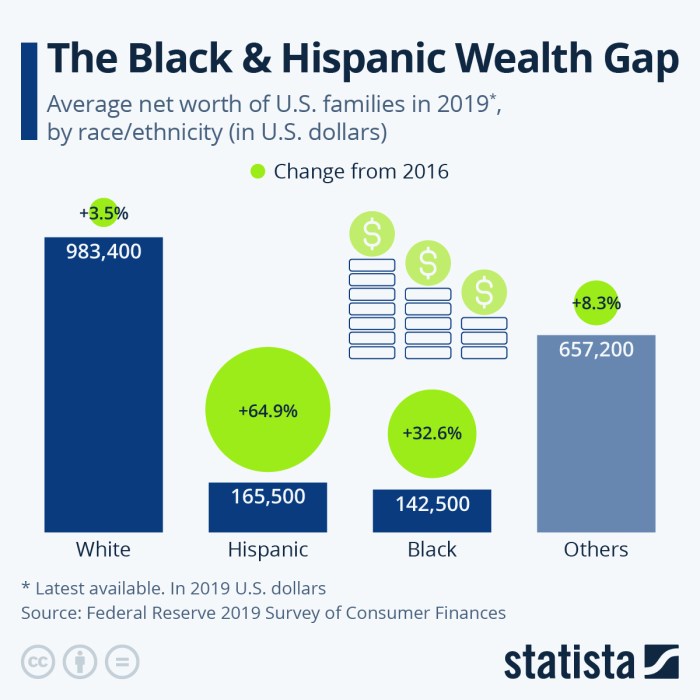
As we continue to address the pressing issue of racial disparities in net worth, it is imperative that we focus on creating economic opportunities for people of color in the United States. By doing so, we can help bridge the wealth gap and foster a more inclusive and equitable society. The statistics are stark: people of color hold just 2% of America’s wealth, despite making up nearly 40% of the population.
This is a stark reminder that systemic inequalities and discriminatory practices have had a profound impact on the economic prospects of marginalized communities.
Developing Inclusive Business Practices
Inclusive business practices are essential for creating economic opportunities for people of color. This can involve implementing diversity and inclusion initiatives, such as recruitment and retention strategies, mentorship programs, and training sessions. Companies can also prioritize supplier diversity, ensuring that they partner with minority-owned businesses to source goods and services.For example, companies like Google, Microsoft, and IBM have implemented supplier diversity programs that have led to increased spending with minority-owned businesses.
These programs not only promote economic opportunities but also help to address systemic inequalities by creating a more level playing field for marginalized communities.
Benefits of Supplier Diversity Programs
- Increased economic opportunities for people of color
- Improved supplier diversity and reduced dependence on a few large suppliers
- Access to new markets and innovative solutions
- Enhanced brand reputation and public image
By prioritizing supplier diversity, companies can not only benefit from a more diverse and inclusive supply chain but also contribute to creating economic opportunities for people of color.
Increasing Access to Education and Job Training
Access to education and job training is a critical component of creating economic opportunities for people of color. This can involve providing scholarships, mentorship programs, and vocational training to help individuals develop the skills and knowledge necessary to succeed in the modern economy.For example, programs like the National Community Leadership Program (NCLP) and the Economic Empowerment Program (EEP) provide leadership development training and entrepreneurship education to individuals from diverse backgrounds.
These programs help to foster a more inclusive and equitable economy, where individuals of all backgrounds have access to the same opportunities.
Benefits of Education and Job Training
- Increased economic opportunities and job prospects
- Improved skills and knowledge, leading to greater competitiveness in the labor market
- Enhanced entrepreneurial spirit and ability to start successful businesses
- Greater mobility and flexibility in the modern economy
By investing in education and job training, we can help create a more inclusive and equitable economy, where individuals of all backgrounds have access to the same opportunities.
Addressing Systemic Inequalities in the Workforce
Systemic inequalities in the workforce have a profound impact on the economic prospects of people of color. This can involve implementing policies and practices that address unconscious bias, provide fair compensation and benefits, and promote work-life balance.For example, companies like Salesforce and Patagonia have implemented policies like flexible work arrangements, parental leave, and paid family leave. These policies not only promote work-life balance but also help to address systemic inequalities by providing fair treatment and compensation to employees from diverse backgrounds.
Benefits of Addressing Systemic Inequalities
- Increased employee satisfaction and retention
- Improved diversity and inclusion in the workforce
- Enhanced reputation and public image
- Greater access to top talent and diverse perspectives
By addressing systemic inequalities in the workforce, we can help create a more inclusive and equitable economy, where individuals of all backgrounds have access to the same opportunities.
FAQ
What is the primary cause of racial disparities in net worth?
The primary cause of racial disparities in net worth is a result of centuries of systemic inequalities, economic policies, and societal norms that have excluded and marginalized people of color.
How do education and employment impact net worth by race?
Education and employment play a significant role in determining net worth by race. Higher levels of education and employment can lead to higher earning potential, better job opportunities, and more substantial net worth.
What is the significance of homeownership rates on net worth?
Homeownership rates have a significant impact on net worth, as owning a home can provide a tangible asset and a source of wealth accumulation. Differences in homeownership rates and property values contribute to net worth disparities between white Americans and people of color.
